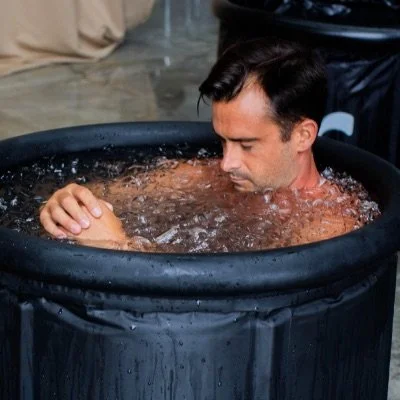
Cold Plunge Temperature Guide for Beginners: Your Safe Starting Point
You have seen the reels. Athletes gasping as they sink into frigid water. Wellness accounts preaching the gospel of the cold. And somewhere in the noise, a simple question keeps surfacing: what is the right cold plunge temperature for beginners?
It is the most important question you can ask before stepping into an ice bath for the first time. Get it wrong and you are either sitting in a lukewarm bath that triggers zero physiological benefit, or you are shocking your nervous system with water so cold it becomes a safety risk. Neither outcome serves you.
This guide gives you the precise temperature ranges, a 6-week progression protocol, and the research behind each step so you can start your cold water immersion practice safely and build toward the kind of resilience that compounds over months.
Why Cold Plunge Temperature for Beginners Matters More Than You Think
Cold water immersion is not a binary switch. It is a spectrum. The physiological response your body mounts at 15°C is fundamentally different from the response at 3°C. And for someone who has never deliberately exposed themselves to cold water, the margin between therapeutic and dangerous is narrower than most people realise.
The Cold Shock Response
When your skin makes contact with cold water, peripheral thermoreceptors fire a cascade of signals. Your sympathetic nervous system activates. Heart rate spikes. Blood pressure rises. Breathing becomes rapid and involuntary: a phenomenon known as the cold shock response (CSR).
This response is not subtle. Tipton et al. (1998), published in the European Journal of Applied Physiology, showed that unhabituated individuals immersed at 10°C showed respiratory rates of 47.3 breaths per minute and heart rates of 128 beats per minute in the first 30 seconds of immersion. These are not trivial physiological events. For experienced practitioners, the cold shock response is manageable. For beginners, it can trigger hyperventilation and, in individuals with underlying cardiac conditions, dangerous arrhythmia.
Crucially, Tipton et al. (1998) also demonstrated that the maximum cold shock response is initiated in water at 10°C, with smaller responses observed at 15°C. This is the scientific basis for starting at 18-20°C rather than jumping straight to the temperatures you see on social media.
Habituation Is a Process, Not an Event
Your body adapts to cold exposure through habituation. With repeated exposure, the magnitude of the cold shock response diminishes. Heart rate and respiratory frequency reduce measurably. The autonomic nervous system becomes more regulated. But this adaptation takes time and repeated exposure.
Barwood et al. (2024), published in the Journal of Thermal Biology, conducted the most comprehensive meta-analysis of cold shock habituation to date, pooling data from 17 groups with 145 participants. Their findings: all CSR variables habituated significantly after approximately 4 immersions, with large effect sizes for heart rate reduction (Cohen's d: -1.19) and minute ventilation (d: -1.64). Critically, they confirmed that this habituation can be achieved by immersion in warmer water than the eventual target temperature: meaning you do not need to start at your end goal to adapt toward it.
Tipton et al. (2000), also from the University of Portsmouth, showed that once achieved, this habituation is long-lasting: respiratory and heart rate attenuation was maintained for 7 months, with heart rate remaining attenuated at 14 months.
The Right Cold Plunge Starting Temperature for Beginners
The best cold plunge starting temperature for someone with no prior cold water immersion experience is between 18°C and 20°C. This range is cold enough to initiate meaningful sympathetic activation and begin the habituation process, while remaining within a margin that allows you to control your breathing and maintain composure.
Why Not Start Colder?
There is a persistent myth in cold plunge culture that colder equals more effective. For beginners, it does not. Tipton et al. (1998) confirmed that the maximum cold shock response occurs at 10°C in unhabituated individuals. Jumping to 5°C on your first session produces an outsized stress response your body is not yet equipped to manage productively. You will likely exit within 30 seconds, having stayed too briefly for any meaningful metabolic or anti-inflammatory benefit, and having created a strong negative association with the practice that makes consistency far less likely.
The athletes and high performers who sustain a cold plunge practice for years are the ones who respected the starting line. Habituation achieved at 15°C transfers directly to performance at 10°C, as Tipton et al. (1998) demonstrated: the adaptation from warmer water is not wasted, it carries over.
Temperature Zones at a Glance
| Temperature | Zone | What Happens |
|---|---|---|
| 18–20°C | Beginner / Acclimation | Mild vasoconstriction, sympathetic activation begins, breath control learnable. Safe entry point for all healthy beginners. |
| 15–18°C | Intermediate | Meaningful norepinephrine release, vasoconstriction pronounced, cold shock response smaller after habituation. Maximum cold shock in unhabituated individuals occurs at 10°C per Tipton et al. (1998). |
| 10–15°C | Performance Zone | Used by elite athletes and habituated practitioners. Significant DOMS and creatine kinase reduction. Wang et al. (2025) identifies 5–10°C for 10–15 min as optimal for CK clearance and neuromuscular recovery. |
| Below 10°C | Advanced Only | Cold shock response maximal in unhabituated individuals. Risk-to-reward ratio shifts unfavourably below 5°C for most people. Do not attempt without established habituation from a structured progression. |
| Sources: Tipton et al. (1998) European Journal of Applied Physiology (n=13); Barwood et al. (2024) Journal of Thermal Biology systematic review and meta-analysis (n=145); Wang et al. (2025) Frontiers in Physiology (55 RCTs). | ||
Your 6-Week Cold Plunge Progression Protocol
The table below is a structured progression designed to take you from complete beginner to confident cold water practitioner. Each week reduces target temperature by approximately 2°C while gradually increasing duration and frequency. This gives your cardiovascular system, nervous system, and psychological resilience time to adapt in concert.
The progression is grounded in the habituation data from Tipton et al. (1998) and Barwood et al. (2024): both confirm that meaningful habituation occurs after approximately 4 immersions, and that adaptation at a given temperature transfers to more challenging temperatures. You are not starting slowly because you are weak. You are starting slowly because the research says that is how habituation works.
| Week | Target Temp | Duration | Frequency | Focus |
|---|---|---|---|---|
| Week 1 | 18–20°C | 1–2 minutes | 3 sessions | Breath control, mental calm |
| Week 2 | 16–18°C | 2–3 minutes | 3–4 sessions | Extending tolerance, slowing exhale |
| Week 3 | 14–16°C | 2–4 minutes | 4 sessions | Building consistency, noting adaptation |
| Week 4 | 12–14°C | 3–5 minutes | 4 sessions | Lowering temperature with confidence |
| Week 5 | 10–12°C | 3–5 minutes | 4–5 sessions | Approaching performance-level temperatures |
| Week 6 | 8–10°C | 3–6 minutes | 4–5 sessions | Sustaining exposure, assessing recovery benefits |
| Progress to next week when you can complete full duration with controlled nasal breathing throughout. Sources: Tipton et al. (1998, 2000) University of Portsmouth; Barwood et al. (2024) J Therm Biol (systematic review and meta-analysis, n=145). | ||||
Track every degree of your progression
You cannot measure your adaptation without knowing your exact temperature.
A floating thermometer designed for water use. Accurate, waterproof, and easy to read. The one tool every beginner actually needs before anything else.
View on AmazonWhen to Progress
Progress to the next week's temperature when you can complete the full duration with controlled nasal breathing throughout. If you are still gasping or tensing at the final minute, stay at your current temperature for another week. There is no benefit to rushing. Tipton et al. (1998) confirmed that habituation at a warmer temperature fully transfers to colder water, so time spent at 18°C is never wasted.
Why Temperature Accuracy Matters
A deviation of 2-3°C changes the physiological demand of a session significantly. A session at 13°C is meaningfully different from one at 10°C, particularly for beginners in weeks 3 and 4 of the protocol. Without a precision chiller, water temperature drifts with ambient conditions, which means your Tuesday session and Friday session may be delivering completely different stimuli without you knowing. This is where purpose-built cold plunge equipment earns its place: not as a luxury, but as a precision instrument.
Critical Safety Considerations for Cold Plunge Beginners
Cold water immersion is a powerful stressor. Managed well, it drives adaptation. Managed poorly, it carries real risk. These are the non-negotiable safety principles for anyone beginning a cold plunge practice.
Never Plunge Alone in Your First Weeks
During your first several weeks, always have someone nearby. Cold shock can cause involuntary gasping, disorientation, or in rare cases, loss of consciousness, particularly in individuals with undiagnosed cardiovascular conditions. A spotter does not need to be in the water. They need to be within arm's reach and aware of what you are doing.
Pre-Screen Your Health
If you have a history of cardiovascular disease, hypertension, Raynaud's phenomenon, or cold urticaria, consult your GP before beginning cold water immersion. The acute spike in blood pressure and heart rate during immersion, documented by Tipton et al. as a blood pressure surge of 30-50 mmHg in the first 30 seconds, is generally well-tolerated by healthy individuals but can be dangerous for those with underlying conditions.
Control Your Breathing Before You Enter
Spend 60 seconds before each session practising slow, deep nasal breathing. A four-count inhale and six-count exhale pattern downregulates your sympathetic nervous system and reduces the baseline anxiety that Barwood et al. (2017) identified as a significant amplifier of the cold shock response. This single habit will improve the quality of every session.
Rewarm Naturally Afterward
Resist jumping immediately into a hot shower after your plunge. The rapid vasodilation can cause dizziness or fainting. Towel off, put on warm layers, and allow your body to rewarm naturally over 10-15 minutes. Light movement accelerates the process safely. This rewarming period is also when the sustained norepinephrine release and parasympathetic rebound produce the alert, clear feeling that regular cold plungers describe.
Track Your Sessions
Log your water temperature, immersion duration, breathing quality, and how you felt afterward. Over weeks, this data becomes your most valuable tool for understanding your personal adaptation curve and knowing when to progress. A floating thermometer or integrated chiller readout is essential for this: you cannot track what you cannot measure.
Frequently Asked Questions
What is the safest cold plunge temperature for a complete beginner?
Start at 18-20°C. This range activates your sympathetic nervous system and begins the habituation process while keeping the cold shock response well within a manageable range. Tipton et al. (1998) demonstrated that at 15°C, the cold shock response is already significantly smaller than at 10°C, and 18-20°C produces a smaller response still: giving you a genuine challenge without the cardiovascular risk of starting too cold.
How long should a beginner stay in a cold plunge?
Start with 1-2 minutes at 18-20°C for your first week. Duration matters far less than consistency in the early stages. A calm, controlled 2-minute immersion 3 times per week will drive more adaptation than a panicked 30-second plunge at 8°C. The Barwood et al. meta-analysis confirms meaningful habituation occurs after approximately 4 immersions: focus on accumulating those sessions before chasing lower temperatures.
Is 10°C too cold for a beginner ice bath?
Yes, in week one. Tipton et al. (1998) specifically measured the cold shock response at 10°C in unhabituated individuals and found respiratory rates of 47.3 breaths per minute and heart rates of 128 beats per minute in the first 30 seconds. This is the maximum cold shock response for unhabituated subjects. You will reach 10°C comfortably within the 6-week protocol: it should not be your starting point.
Do I need a chiller to control my cold plunge temperature?
If you are serious about building a structured practice, yes. Without a chiller, water temperature drifts with ambient conditions. A deviation of 2-3°C within your current protocol week changes the physiological demand of the session in ways you cannot see or measure. A precision chiller ensures every session is deliberate, measurable, and repeatable. That is the difference between a structured progression and a guessing game.
Can cold plunges be dangerous?
Cold water immersion carries risk when done recklessly, particularly at very low temperatures, without supervision, or by individuals with undiagnosed cardiovascular conditions. The cold shock response identified by Tipton and colleagues at the University of Portsmouth has been linked to open-water drowning deaths in unhabituated individuals. However, when approached with a structured progression protocol, appropriate starting temperatures, and basic safety practices, cold plunging is a well-tolerated practice used across a wide range of athletic populations.
Final Thoughts
The best cold plunge temperature for beginners is not the coldest one you can survive. It is the one that lets you build a practice you will maintain for years.
Start at 18-20°C. Master your breathing. Progress methodically using the 6-week protocol above. Track every session. Within six weeks you will be operating at temperatures that would have felt impossible on day one, and you will be building them on a foundation of genuine physiological adaptation rather than ego-driven discomfort.
The science from Tipton et al. at the University of Portsmouth and Barwood et al.'s 2024 meta-analysis is clear: habituation is real, it is measurable, and it transfers from warmer to colder water. The protocol works. The variables that determine whether you access it are your starting point, your consistency, and whether your equipment holds the temperature it says it does.
At Ritual Recovery, our ice baths and chillers are engineered to hold within 0.5°C of your target temperature, session after session. Because the difference between a therapeutic cold exposure and a cold bath that drifts unpredictably is the difference between a protocol and a guess. Start where you are. Progress with purpose. And never underestimate the power of doing it right from day one.