Why Your Feet Hurt in the Ice Bath (And What to Actually Do About It)
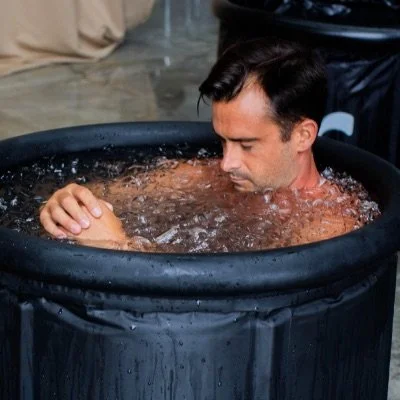
You lower yourself into the ice bath. Breath steady, body tense but holding. And then it hits you.
Not in your legs. Not in your chest. In your feet.
That sharp, almost burning pain shoots through your soles and makes you want to jump straight back out. For most people, it is not toughness or mental fortitude that cuts a session short. It is the feet — within the first twenty or thirty seconds, before the session has even properly begun.
This is not a weakness. It is anatomy. And once you understand why it happens, you can do something about it.
The Science Behind Why Feet Hurt More Than Anything Else
It seems strange. Your thighs, your core, your chest — they can tolerate cold water for minutes at a stretch. But your feet feel like they're being held against dry ice within seconds of immersion. The reason comes down to a specific type of skin your feet are built from, and what that skin is wired to do.
Glabrous Skin: The Real Reason Your Feet Are Different
The soles of your feet are covered in what neurologists call glabrous skin — the hairless, non-follicular skin found only on the palms of your hands, the fingertips, and the plantar surface of your feet.
Glabrous skin is fundamentally different from the skin covering the rest of your body. It has no hair follicles, no sebaceous glands, and no layer of peach-fuzz insulation. What it does have, in exceptional density, is mechanoreceptors and thermoreceptors — specifically TRPM8 ion channels, which are cold-activated receptors that begin firing pain and temperature signals at temperatures below approximately 15°C.
On hairy skin, a layer of follicle and subcutaneous tissue acts as a modest buffer between the cold stimulus and the nerve endings. On glabrous skin, that buffer does not exist. Cold water at 10 to 15°C makes direct contact with the highest concentration of cold-sensitive nerve endings in the human body.
The signal is not filtered. It is immediate, intense, and interpreted by the brain as threatening.
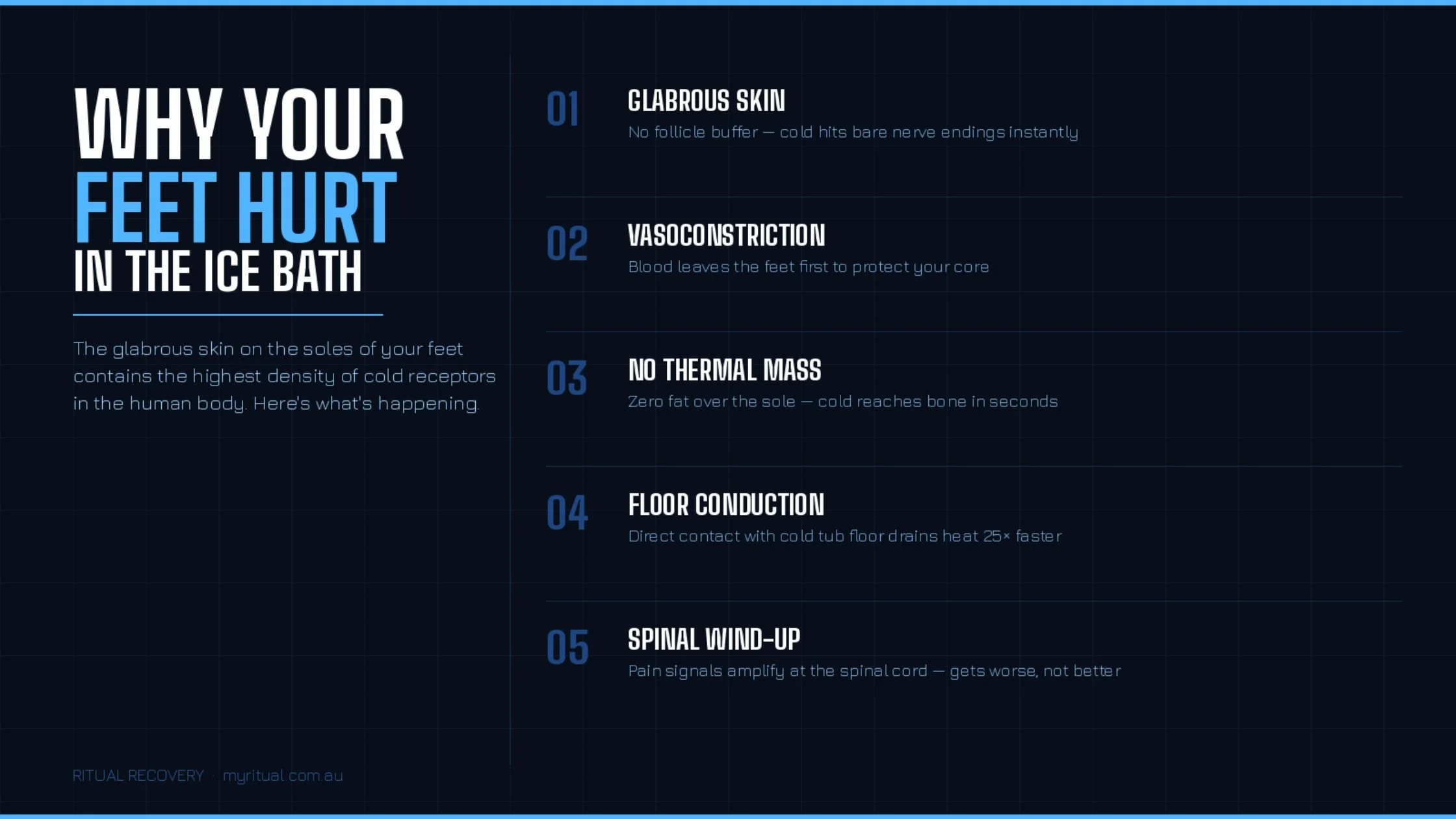
The Five Mechanisms Working Against Your Feet
The glabrous skin issue is only the beginning. There are four additional physiological mechanisms that compound the pain, all firing simultaneously:
1. Peripheral vasoconstriction cuts blood supply fast
The moment cold water contacts your skin, your autonomic nervous system triggers the cold shock reflex. Blood is immediately shunted from the distal extremities toward the core to protect vital organ temperature. Your feet are the furthest point from the core — they lose perfusion within seconds. The result is rapid ischaemia: tissue starved of warm blood, which amplifies the cold pain signal already firing from your TRPM8 receptors. Two pain mechanisms are now running in parallel.
2. Zero thermal insulation over the plantar sole
Your thighs and torso carry meaningful layers of subcutaneous fat. That fat acts as a thermal buffer, slowing the rate at which cold penetrates to the nerve endings. The plantar sole of the foot has almost none. Foot tissue is primarily bone, tendon, fascia, and thin glabrous skin. Cold water penetrates to the temperature of the bath within 30 to 60 seconds — far faster than any other body part.
3. Conductive heat loss through the tub floor
Conduction transfers heat approximately 25 times more efficiently than convection. When your feet rest on the floor of the tub — typically stainless steel or acrylic — they are not just surrounded by cold water, they are in direct sustained contact with a surface that actively conducts heat away from the sole continuously. This is why standing in an ice bath hurts more than floating in one. The floor compounds every other mechanism simultaneously.
4. Spinal wind-up makes it get worse, not better
Here is the part most people do not expect: the feet often feel more painful after the first minute than they did at the moment of entry. This is due to a neurological process called dorsal horn wind-up — repeated C-fibre activation from the foot causes each incoming pain signal to be progressively amplified at the spinal cord level. The brain begins registering pain disproportionate to the stimulus. Remaining completely still allows this process to accelerate. Movement breaks the cycle.
The Foot Pain Timeline in a Cold Plunge
Understanding roughly what happens across the first few minutes helps you make decisions in the moment, rather than reacting to pain that feels random.
| Time in Session | What's Happening | What It Feels Like |
|---|---|---|
| 0–15 seconds | TRPM8 receptors in glabrous skin activate on contact below 15°C | Sharp, immediate sting across the sole |
| 15–45 seconds | Cold shock reflex triggers peripheral vasoconstriction | Burning, ischaemic pain adds to the receptor signal |
| 45–90 seconds | Conductive heat loss through tub floor accelerates; thermal mass depleted | Pain intensity peaks — this is where most people exit |
| 90–180 seconds | C-fibre wind-up progresses if body is still; cold shock reflex begins to dampen | Pain either plateaus or builds depending on movement and breathing |
| 3–5 minutes | Cold adaptation starts; peripheral nerves slow conduction; body begins to habituate | Gradual shift from sharp pain to dull, manageable cold sensation |
| 5+ minutes | Sympathetic nervous system downregulates; norepinephrine elevation sustained | Feet become largely numb; session becomes manageable |
The critical insight from this table: the 45 to 90 second window is where the real battle happens. Not because the pain is permanent, but because most people exit before the adaptation phase even begins. The session ends at exactly the wrong moment.
What Actually Helps: Five Things That Work
The foot pain is real and the physiology behind it is not optional. But there are specific interventions that genuinely reduce it — some behavioural, one equipment-based.
1. Move Your Feet — Don't Stay Still
This is the single most effective immediate intervention and the one most people ignore because they are focused on breathing and enduring.
Wiggling your toes, rotating your ankles, and pressing and lifting your heels disrupts both the vasoconstriction pattern and the C-fibre wind-up cycle. Movement stimulates peripheral circulation, breaks the ischaemia feedback loop, and introduces fresh, cold (but slightly warmer) water over the sole rather than the same static column of water that has been conducting heat away continuously.
It does not need to be dramatic. Even small, continuous movement makes a measurable difference to perceived foot pain intensity.
2. Get Your Breathing Right Before the Feet Become the Problem
The cold shock response — the gasping, the heart rate spike, the instinct to escape — is not driven by the feet specifically. It is a whole-body autonomic response. But the feet often become the focal point because the rest of the body is managing the shock reasonably well while the feet are not.
Controlled nasal breathing, specifically extending the exhale, activates the parasympathetic nervous system and begins to counteract the autonomic cold shock response. If you get your breath pattern established in the first fifteen seconds, before the foot pain peaks, you are in a significantly stronger position at the 60 to 90 second mark where most sessions fail.
The sequence matters: breathe first, then manage feet — not the other way around.
3. Warm Up Beforehand
Light physical activity before a cold plunge — ten minutes of movement, a short walk, some bodyweight exercise — elevates peripheral circulation before immersion. Well-perfused feet entering cold water are not painless, but they lose their thermal mass more slowly and the ischaemic component of the pain is delayed by the pre-existing blood flow.
This is also why contrast therapy (alternating sauna and cold plunge) is the most effective protocol for managing foot pain. The heat phase warms the periphery fully before cold immersion. The feet enter the plunge with elevated perfusion that meaningfully delays the worst of the pain.
4. Adjust Your Temperature Gradually
If you are new to cold immersion and jumping straight into water at 10°C, the foot response will be severe. Starting at 15 to 18°C and building toward lower temperatures over several weeks gives your peripheral nervous system time to adapt. Cold adaptation is real — experienced cold plunge practitioners report significantly attenuated foot pain compared to beginners at identical temperatures, because repeated TRPM8 exposure downregulates the receptor response over time.
This is not weakness. This is sensible progressive exposure, the same principle used in any training protocol.
5. Protect Your Feet With Ice Bath Socks
Behavioural adjustments help, but they do not eliminate the underlying problem: glabrous skin in direct contact with cold water and a cold conductive floor. Ice bath socks address this at the source.
Ice Bath Socks: Why They Work and When They Are Worth It
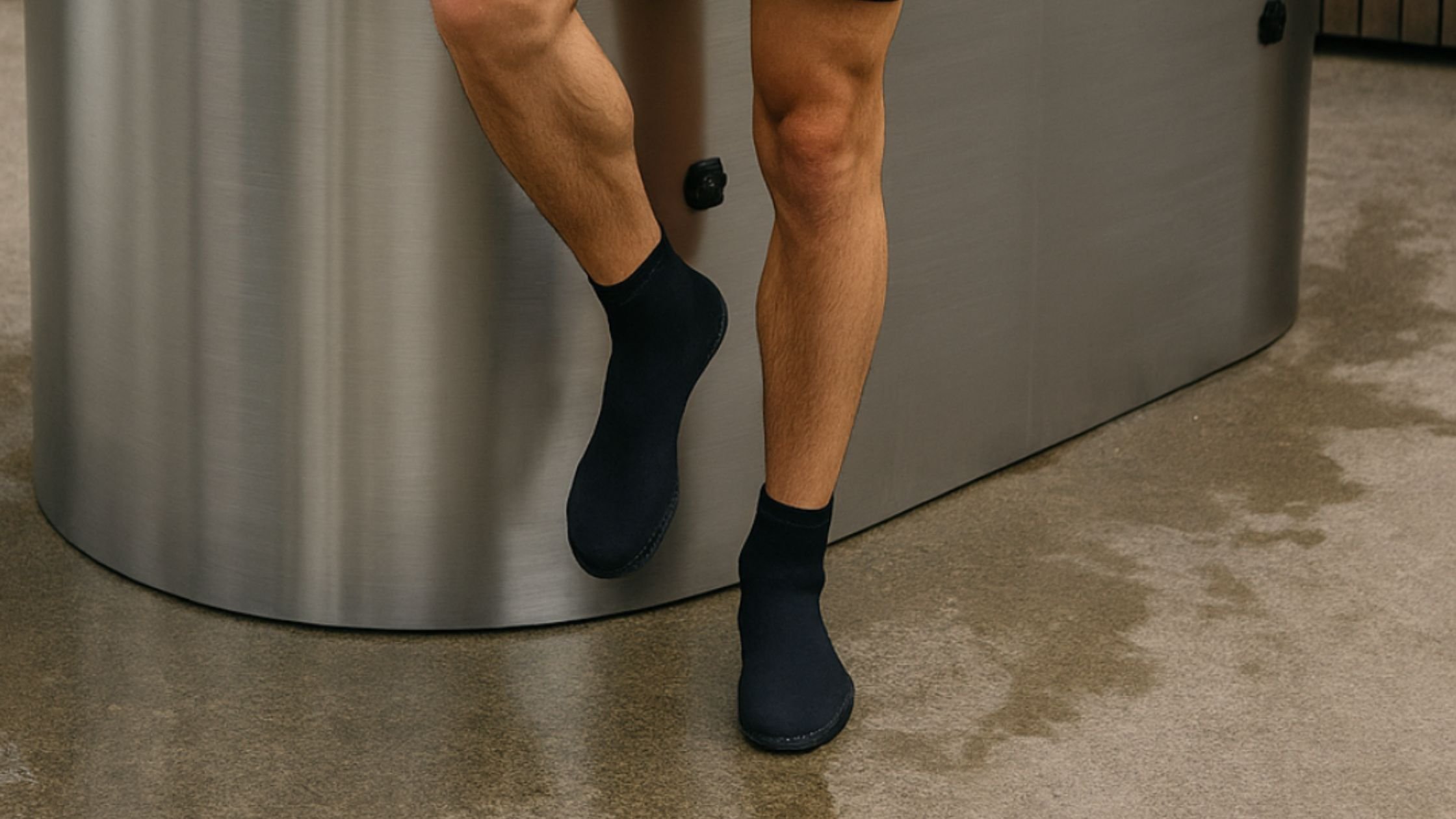
Ice bath socks are neoprene or insulating material garments that cover the foot and lower ankle during cold immersion. They are not thick enough to prevent cold from reaching the foot — they are not designed to. Their function is more precise than that.
Neoprene is a closed-cell foam rubber that traps a thin layer of water against the skin. The body warms that water layer, which then acts as a thermal barrier between the skin and the colder surrounding water. This is identical to how a wetsuit works for surfers and divers in cold ocean water.
In an ice bath context, the effect is to:
Reduce the direct TRPM8 stimulation from water below 10°C (the water against the glabrous skin is slightly warmer than the bath temperature)
Eliminate the conductive heat loss from direct tub floor contact — the most overlooked contributor to foot pain
Slow the rate of peripheral ischaemia by insulating the foot from the most extreme cold gradient
Allow the practitioner to habituate to the overall cold without the feet becoming the limiting factor
The result is not a pain-free experience. Cold immersion remains demanding. The result is that the feet stop being the weakest link — the thing that forces an exit before the session has delivered its full effect.
What to Look For in Ice Bath Socks
| Feature | What to Look For | Why It Matters |
|---|---|---|
| Neoprene thickness | 2mm–3mm | Thicker insulates more but reduces feedback; 2mm is the sweet spot for most users |
| Sole coverage | Full plantar coverage, no open-toe | Open-toe designs leave the most sensitive glabrous zone exposed |
| Ankle height | Mid-ankle minimum | Below-ankle designs miss the Achilles and lower ankle cold conduction points |
| Fit | Snug without constricting | Loose neoprene allows cold water to flush through and breaks the insulating layer |
| Entry design | Rear zip or pull-on | Zip entry is easier to manage with cold, stiff fingers mid-session |
| Sole reinforcement | Avoid surf/dive booties with thick soles | Thick soles add bulk without recovery benefit; plantar flexibility matters in the plunge |
Where to Find Them in Australia
Ice bath socks are not stocked widely in Australian sports retailers. They are a niche recovery product, and the market is still catching up to demand from the cold therapy community.
Ritual Recovery stocks neoprene recovery socks specified for cold plunge use — not surf or dive booties adapted from another purpose, but socks designed specifically for the plunge context. Shop the Ritual Recovery Ice Bath socks here.
Online generally: Amazon stocks a range of neoprene socks with mixed quality — read reviews specifically from cold plunge users rather than surfers, as the use case requirements are different.
Surf and dive shops: These carry neoprene socks, but they are typically overbuilt for cold plunge purposes. The reinforced soles, thicker panels, and fin-strap cutouts add cost and bulk without adding recovery value. They will work; they are not optimal.
The Honest Caveat: Socks Are a Tool, Not a Crutch
Ice bath socks reduce foot pain and extend session duration. They are a legitimate, practical tool for anyone whose cold therapy practice is being limited by foot pain.
They are not, however, a solution to poor protocol discipline. If you are entering the plunge without controlling your breath, staying completely still, and exiting at the first sign of discomfort, socks will help — but the bigger return comes from addressing the breath and movement fundamentals first.
The optimal approach is both: develop the breath and movement protocol, and use socks as an additional layer that makes the foot-pain problem largely disappear. The session then becomes about the breath, the mental discipline, and the recovery goal — which is what it was always supposed to be about.
The Body Part That Determines Whether You Actually Get the Benefits
Here is the practical reality of cold therapy: the documented benefits — reduced inflammation, elevated norepinephrine and dopamine, DOMS reduction, metabolic activation — require staying in the water long enough for those physiological responses to develop. The Søberg Protocol specifies eleven minutes per week of cold water immersion at consistent temperature. You cannot accumulate that dose if your feet are forcing you out in under two minutes every session.
The feet are not the enemy. They are wired to be sensitive, and that sensitivity serves an important protective function. But in a controlled cold therapy context, that sensitivity is not protecting you from anything — it is just limiting the session.
Understanding why it happens is the first step. Managing it with the right combination of technique and equipment is the second. Your feet will adapt over time. They just need the right conditions to get there.